Samba dance history begins with Afro-Brazilian roots, shaped by African rhythm, movement, music, and community life in Brazil. It grew strongly in Bahia, spread to Rio de Janeiro, and became internationally visible through Carnival, recordings, samba schools, and later stage and ballroom styles.
Samba is not only a dance step or parade image. It is music, social memory, cultural identity, and a family of movement traditions. To understand the origin of samba dance, follow a clear route: African traditions → Bahia → Rio → Carnival → modern styles.
What is samba dance history?
Samba dance history is the story of how African-rooted rhythms and dances developed inside Brazil, especially through Afro-Brazilian communities. By the early 1900s, samba had become strongly associated with Rio de Janeiro, but its deeper roots reach through Bahia, the Recôncavo region, and African cultural practice carried across the Atlantic.
If someone asks “what is samba dance,” the answer depends on context. Samba can mean a musical genre, a family of dances, a Carnival parade tradition, a partnered Brazilian social dance, or a standardized International ballroom style. That is why the history of Brazilian samba dance can feel confusing: many forms share the name, but they do not all look the same.
The common thread is rhythm and grounded movement. Samba often uses a bouncing action through the knees and ankles, quick weight transfers, syncopated timing, and a strong relationship to percussion. In performance forms, dancers may show fast footwork, hip action, and expressive upper-body styling; in social forms, the emphasis may be more communal, conversational, playful, or partnered.
A useful way to read samba history facts is by geography. Bahia helps explain the Afro-Brazilian roots and samba de roda. Rio de Janeiro helps explain urban popularization, recordings, and Carnival visibility. Modern branches then show how one tradition can live in solo, social, and dance-sport settings without becoming a single uniform technique.

Where did samba originate? African roots, semba, and batuque
The question “where did samba originate” has a layered answer. Samba is Brazilian, but it grew from African-rooted cultural practices carried, preserved, and reshaped by enslaved Africans and their descendants. West and Central African musical ideas, call-and-response singing, percussion, circular dancing, and community gathering structures all helped shape what later became samba.
Batuque is one important term. In Brazil, Batuque referred broadly to African-derived drumming and dance gatherings. These events were not only entertainment; they were social spaces where rhythm, movement, faith, resistance, and community memory could survive under colonial pressure. For dancers, that context matters because samba’s grounded quality is part of a wider African-diasporic movement vocabulary, not just a decorative bounce.
Semba is often discussed as a linguistic and cultural connection. The word is associated with Angolan tradition, and scholars commonly connect it to ideas of a dance invitation or a belly-touching gesture in communal dance. Samba did not simply copy Semba, and there is no single straight line from one term to the other. Still, the relationship helps explain cultural continuity across language, rhythm, and social dance practice.
This matters for beginners studying the samba dance origin because the body action is not random. The bent-knee pulse, weight into the floor, and rhythmic footwork reflect movement values from communal dance traditions: conversation with percussion, movement shared in a group, and energy that travels through the whole body.
Avoid looking for one inventor or one exact birthday. Samba developed over generations. It is better understood as a living Afro-Brazilian process than as a single moment of creation.
From Bahia to Rio: how samba became a city dance
Bahia is central to Brazilian samba dance history because Afro-Brazilian communities there preserved and developed forms such as samba de roda. In samba de roda, dancers, singers, and musicians gather in a circle, with movement shaped by clapping, percussion, song, and social participation. For beginners, its cultural role is easiest to understand this way: the circle lets the community make music and movement together, while one dancer may step into the center with small grounded steps, a soft bounce, and responsive footwork.
As people moved from Bahia and other regions into Rio de Janeiro, samba entered new urban spaces. Houses, yards, neighborhood gatherings, religious communities, street celebrations, and popular music circles became places where rhythms and steps mixed. This is why samba has no single birthplace in the simple sense. Bahia was a major cradle; Rio became a major amplifier.
Early 20th-century Rio was growing quickly, and urban life shaped samba’s public identity. Musicians, dancers, workers, migrants, and Afro-Brazilian communities all contributed to the style’s spread. The dance became more visible in the city while still carrying older cultural memory. Rather than imagining samba as “invented” in one room, it is more accurate to picture a network of communities exchanging rhythm, song, and movement.
| Place or stage | Why it matters | Dance and music clue |
|---|---|---|
| African roots | Source of rhythm, call-and-response, and communal movement | Grounded pulse, percussion, circular participation |
| Bahia | Major cradle of samba de roda and Afro-Brazilian continuity | Circle stepping, clapping, singing, social exchange |
| Rio de Janeiro | Urban popularization in the early 1900s | Neighborhood gatherings, recordings, Carnival growth |

1917 and 'Pelo Telefone': the first recorded samba milestone
One of the best-known samba history facts is the 1917 success of “Pelo Telefone.” It is widely cited as an early recorded samba milestone and is often linked to the popular spread of samba through recordings, publishing, and urban culture in Rio de Janeiro.
That does not mean samba began in 1917. The deeper tradition was already older, rooted in Afro-Brazilian communities, dance gatherings, religious and social spaces, and musical practice. “Pelo Telefone” matters because recording technology and commercial publishing helped carry samba beyond local circles. It gave samba a public marker in the expanding world of popular music.
It is also worth being historically careful: early samba authorship and ownership were often complicated, and some songs grew from collective musical environments before being credited in print or on recordings. That context reminds us that samba developed through community creativity, not only through named composers.
For dancers, recordings changed how rhythm could travel. Once songs circulated, steps, accents, and musical expectations could move across neighborhoods and later across countries. Samba’s syncopation became something listeners could study repeatedly, not only experience in live community settings.

How samba schools and Carnival changed the dance
Samba schools helped make samba one of Brazil’s most visible cultural symbols. A samba school is not just a class provider; it is a community organization that prepares music, costume, choreography, percussion, parade identity, and neighborhood representation for Carnival. These groups gave samba a larger public structure while keeping strong ties to local pride and collective work.
Carnival changed samba by scaling it up. Movement that could be social, circular, and close to the ground also became theatrical, fast, and visually powerful. Large groups needed structure, formations, entrances, exits, stamina, and clear musical coordination. The public image of samba became brighter and more spectacular, especially for viewers outside Brazil.
This is where many people first encounter samba no pé, the solo style often associated with Carnival. It uses quick rhythmic steps under the body, a lively grounded bounce, expressive hips, and arms that project energy without losing the pulse. The dancer’s weight shifts rapidly, so ankle control, knee softness, and musical timing matter.
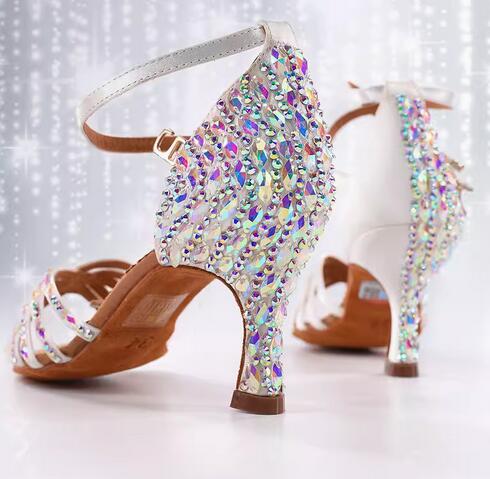
For dancers studying Carnival-inspired samba, footwear is usually discussed in practical terms rather than glamour alone. Heel stability helps control fast weight changes, straps help keep the foot secure, and suede soles are commonly preferred on indoor dance floors because they allow turns and pivots without the stickiness of street soles.
| Feature | Community or social samba | Carnival parade samba |
|---|---|---|
| Main setting | Gatherings, circles, clubs, neighborhoods | Parade routes and large public performance |
| Movement focus | Participation, rhythm, social connection | Energy, projection, stamina, spectacle |
| Organization | Informal or community-led | Samba schools, sections, choreography, costumes |
| Dancer demand | Musical listening and shared rhythm | Endurance, visibility, balance, repeated footwork |
The styles that grew out of samba: samba no pé, gafieira, and ballroom
Modern samba includes several related but distinct styles. Samba no pé is usually solo and strongly linked to Carnival and social expression. The feet work quickly under the hips, often with a springy pulse and relaxed upper-body confidence. It may look effortless, but good samba no pé depends on timing, stamina, knee softness, and the ability to keep the bounce grounded rather than jumping upward. Our step-by-step guide to dancing samba breaks the basic bounce down slowly.
Samba de gafieira is a partnered social dance from Brazilian ballroom culture. It uses lead and follow, turns, traveling patterns, redirections, and a smoother partnered frame. The posture is more connected than solo samba, but the rhythm still keeps a Brazilian swing and playful timing. Gafieira also shows how samba moved into urban dance halls while keeping a strong relationship to Brazilian music.
International samba is different again. It is the standardized ballroom version used in dance sport. It includes codified figures, bounce action, sharper presentation, and technique shaped for competition floors. It is influenced by Brazilian samba, but it is not the same as samba de roda, samba no pé, or Carnival samba.
| Style | Usual format | Key movement idea |
|---|---|---|
| Samba no pé | Solo | Fast footwork, bounce, hip action, Carnival energy |
| Samba de gafieira | Partnered social | Lead and follow, turns, traveling patterns |
| International samba | Ballroom dance sport | Standardized figures, bounce action, performance technique |
| Style | Typical setting | What beginners often confuse |
|---|---|---|
| Samba de roda | Community circle, especially tied to Bahia | Thinking it is the same as parade samba |
| Samba no pé | Carnival, social solo practice, performance | Assuming speed matters more than rhythm |
| Samba de gafieira | Brazilian social dance halls | Expecting it to use the same frame as International samba |
| International samba | Ballroom training and dance sport | Treating it as the direct “original” samba |
Why samba matters: culture, identity, and UNESCO recognition
Samba matters because it carries Afro-Brazilian identity, resilience, and creativity. It is not only a festival style; it is a living cultural practice shaped by communities who preserved rhythm, movement, and social meaning across generations. For beginners, samba de roda shows this clearly: people gather in a circle, keep the rhythm with clapping and percussion, and support a dancer who steps into the center with grounded bounce and responsive footwork.
UNESCO recognition also shows this importance. Samba de roda from the Recôncavo of Bahia was recognized as intangible cultural heritage, drawing global attention to its cultural depth. That recognition supports a broader truth: samba is not frozen history. It continues to live in neighborhoods, stages, Carnival, social dance, and international study.
For dancers, learning samba respectfully means listening to the music, understanding the roots, and noticing the differences between styles. The more clearly the history is understood, the less likely samba is reduced to costume, speed, or spectacle alone.
FAQs
Where did samba originate?
Samba originated through Afro-Brazilian cultural development, with strong roots in Bahia and later expansion in Rio de Janeiro. Its foundations include African-derived traditions such as Batuque, percussion gatherings, call-and-response singing, and the commonly cited connection to Semba. There is no single invention date. A useful takeaway is to think of samba as a cultural evolution: African roots were preserved, reshaped, and carried into Brazilian music, dance, and community life over generations.
Is samba African or Brazilian?
Samba is both African-rooted and Brazilian. Its form developed in Brazil, especially through Afro-Brazilian communities, but many of its rhythms, movement values, and communal structures come from African cultural traditions. Avoid a false either/or answer. In dance terms, the grounded bounce, syncopation, and full-body rhythm show continuity with African-derived movement. When studying samba, pair step practice with listening practice so the body action stays connected to the music.
How old is samba?
Samba is older than its first famous recordings. Its popular urban visibility grew in the early 20th century, but its roots reach back through 19th-century and earlier Afro-Brazilian community traditions. The year 1917 matters because “Pelo Telefone” became a widely cited recorded milestone. It should not be treated as samba’s birth date. A practical study tip is to separate “recorded popularity” from “cultural origin” when reading samba timelines.
What is the difference between samba de roda and Carnival samba?
Samba de roda is a community-based Bahian form with strong African heritage, often organized around a circle of singers, musicians, clapping, and dancers. Carnival samba is a public parade and performance expression shaped by samba schools, costumes, percussion sections, and large-scale choreography. Both belong to the wider samba family, but their goals differ. To tell them apart, look at setting: circle-based participation suggests samba de roda, while parade projection suggests Carnival samba.
What is the first recorded samba song?
“Pelo Telefone,” released in 1917, is widely cited as an early recorded samba milestone. It helped samba reach a broader public through recording, publishing, and urban media culture. Still, it did not create samba’s deeper roots, which were already present in Afro-Brazilian communities. The best takeaway is to remember 1917 as a landmark in popular spread, not as the origin point. For dancers, recordings also made rhythmic study more repeatable.
How does samba differ from ballroom samba?
Ballroom, or International samba, is a standardized dance-sport style influenced by Brazilian samba but developed with its own technique. It uses codified figures, posture, bounce action, and performance expectations suited to ballroom competition. Social and Carnival samba forms are more directly tied to Brazilian community, parade, or club contexts. The actionable distinction is this: do not assume one set of steps represents all samba. Match your technique study to the specific style being learned.
What shoes are best if I want to try samba after learning the history?
For samba-inspired practice on indoor dance floors, look for secure straps, a stable low-to-mid heel, and a suede sole that allows controlled turns without sticking. Absolute beginners usually do better avoiding 3-inch or higher heels while building ankle strength and weight-transfer control. Measure both feet, check the size chart, and consider width notes before ordering online. Heel shape, strap placement, and sole material should match the samba style and floor surface.
Conclusion
Samba’s history runs from African-rooted rhythm and movement into Bahia’s samba de roda, Rio de Janeiro’s urban culture, the 1917 “Pelo Telefone” milestone, and the public power of Carnival and samba schools. Its modern branches—samba no pé, samba de gafieira, and International samba—share a name, but each has its own setting and technique. Respecting that history makes the dancing richer. If samba’s rhythm has inspired your next practice or performance goal, TTdancewear offers online size-chart guidance across samba shoes, Latin styles for secure, dance-focused movement. For Carnival-style sparkle, rhinestone dance shoes add stage shine, and the heel and size guide helps with fit.